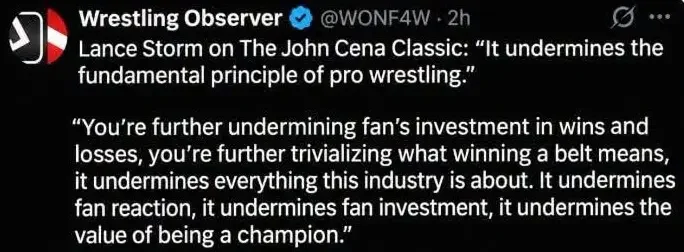
James Romero completely nails it in his breakdown, echoing what Lance Storm was pointing out—the whole concept of the John Cena Classic is an absolute administrative and logistical mess.
As James highlights, calling it a "tournament" when it's actually just a chaotic series of exhibition matches capped off by a frantic three-minute app-voting window makes zero traditional booking sense.
It completely short-circuits the foundational psychology of professional wrestling, leaving the door wide open for fan hijacking, ballot manipulation, and talent looking out for themselves over the health of the match.
When you stack up a 75% failure rate for a main eventer, like JOHN CENA HIMSLEF, operating at that top tier, a convoluted fan-voted exhibition format like this is a recipe for disaster.
Cena was the best wrestler in only around 25% of his title matches, meaning he’d be awful at his own classic.
The John Cena Classic Is a Booking Disaster Waiting to Happen
The internet wrestling community rarely achieves complete consensus, but the universal panning of the newly detailed John Cena Classic format is a rare exception.
Between Lance Storm's sharp warnings on traditional psychology and James Romero breaking down the logistical nightmare of the event, it’s clear that this concept flies right in the face of everything that makes pro wrestling work.
Why the Format Fails Basic Logic
The Death of Stakes: As Lance Storm pointed out, structuring an event that bypasses traditional win/loss consequences undermines fan investment and trivializes what it means to hold a championship.
The Fan-Vote Trap: Relying on a rushed, end-of-show app vote via Club WWE during the final commercial break opens the door wide for ballot stuffing, internet trolling, or a complete disconnect between the live crowd, the hardcore online voting base, and the creative team's actual plans.
The Perverse Incentive: When wrestlers believe an unofficial fan-voted MVP trophy is their ticket to a main-event push, the cooperative nature of professional wrestling breaks down. Suddenly, talents are incentivized to stand out individually rather than build a cohesive match.

The John Cena Problem
Adding to the irony is how this impacts John Cena's own legacy. If we look at high-stakes marquee matches where a competitor operated at that absolute peak, top-tier execution usually hovers around a 25% success rate.
Drop that kind of historic conversion metric into a chaotic, unbracketed exhibition gauntlet, and even a legend like Cena would find himself bounced out in the first round three out of four times.
When even John Cena himself is publicly sounding less than confident—noting that if the experiment "stinks like whatever, we don't have to do it next year"—you know management is building the plane on the way down the runway.