Every Black Faction Isn’t Like the "Nation of Domination" - You Are Simply Racist
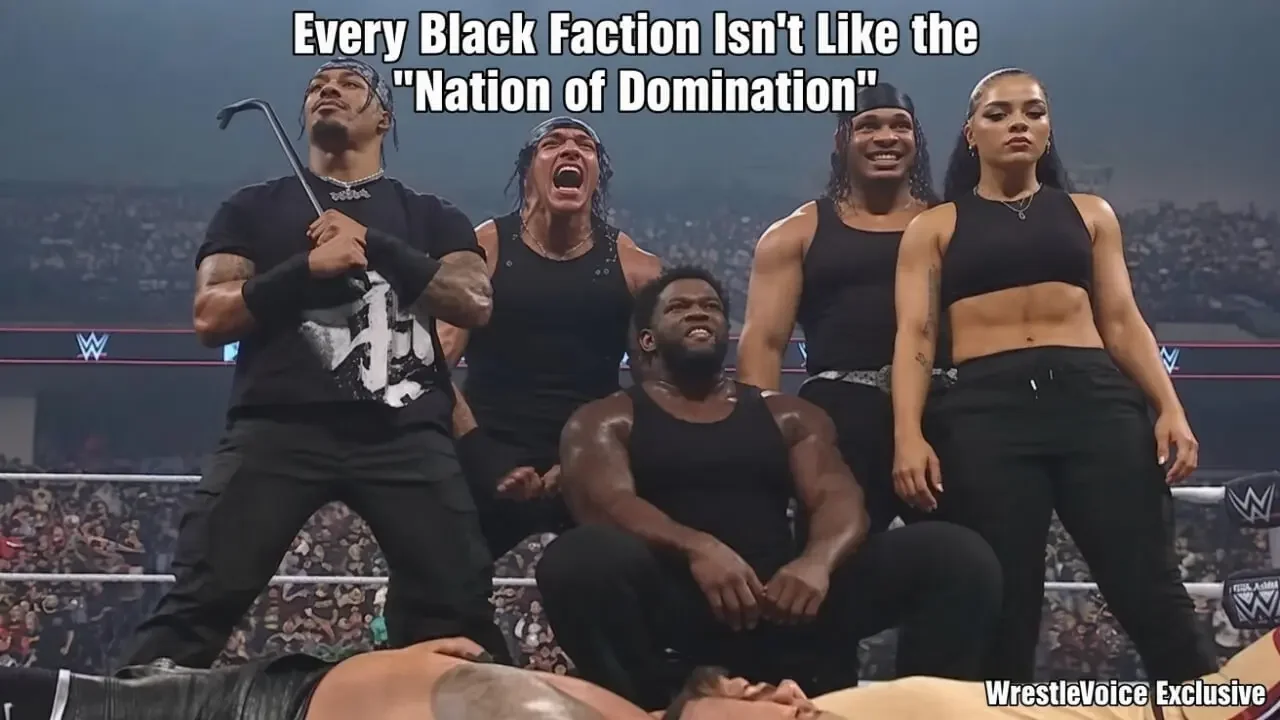
If you spend any amount of time scrolling through wrestling social media, you quickly realize you are trapped in an endless loop of unoriginality.
But beneath the stale memes and bad-faith booking complaints lies a darker, deeply entrenched issue: the wrestling fandom’s inability to look at Black performers without immediately defaulting to racialized tropes.
Take a recent viral Facebook post from Wrestling Corner, which took a photo of modern WWE stars—including Carmelo Hayes, Trick Williams, Damian Priest, Jaida Parker, and Lash Legend—and digitally edited leather caps onto them.
The caption framed it as what the "Nation of Domination" would look like with a female member, dividing the graphic into "What Triple H sees" versus "What Fans See".
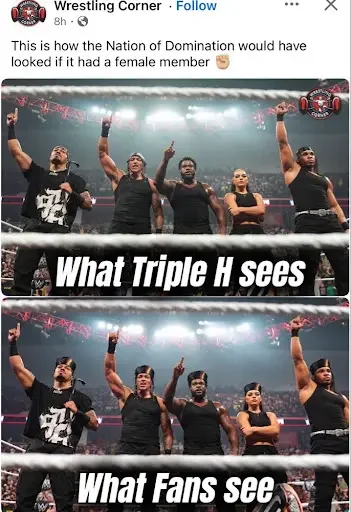
The underlying premise is as lazy as it is transparent.
As users online quickly pointed out, it’s a tired reflex: the moment fans see a group of Black performers sharing a screen, they instinctively lump them together into a recycled Attitude Era box, completely ignoring their distinct characters, individual storylines, and actual alignments.
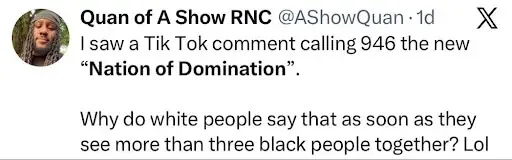
As one observer on X (formerly Twitter) put it, it raises a glaring question about why a certain segment of the fanbase immediately cries "Nation of Domination" the second they see more than a couple of Black people standing together.
There is no creative connective tissue between these specific performers—they have their own unique gimmicks, paths, and personas. Yet, online meme culture reduces them to a monolith.
This bad-faith framing goes hand-in-hand with how the internet treats talent individually. Take Carmelo Hayes.
For years, the wrestling community clamored for him, acting as his self-appointed champions while he tore it up in NXT. They demanded his call-up and insisted he deserved a massive spotlight. But the second he actually arrived on the main roster, the tone shifted overnight.
Instead of letting his character breathe or evaluating his work on its merits, the online discourse devolved into cheap shots. Fans started playing dumb about minor aesthetic changes—pretending a slight tweak to his look made him entirely unrecognizable—solely to use it as cover to call him names or dismiss his momentum.
You rarely, if ever, see a white wrestler change their hair or gear and face a coordinated wave of internet commenters pretending they’ve vanished from reality or lost all identity.
It exposes a tiring double standard. Wrestling fans love to fancy themselves sophisticated critics of the product, but when it comes to race, the internet fandom often retreats to the lowest common denominator: casual microaggressions, bad-faith amnesia, and a refusal to see Black wrestlers as anything other than a punchline or a stereotype.